
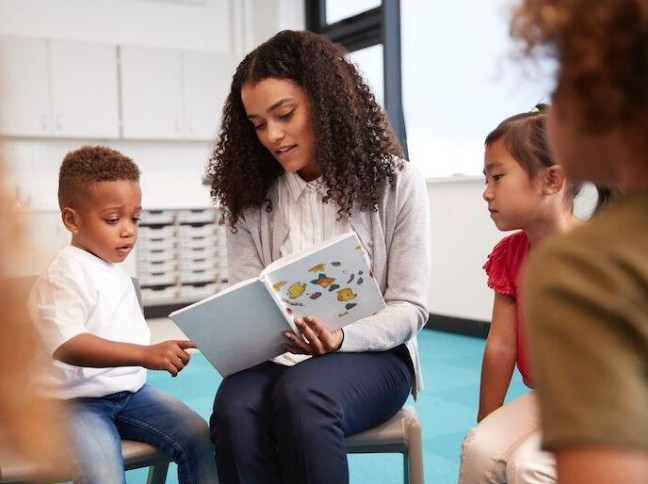
Across the United States, the number of students with disabilities has skyrocketed in recent years1. Here in DC, many of the Co-op’s member schools report experiencing this increase most acutely in their preschool programs, with rising numbers of students entering PreK – many with high needs in multiple areas, including communication, behavior, and pre-academic skills.
The urgency of ensuring that all early childhood educators have the training and support they need to provide high quality inclusive programming has never been greater. For 3 and 4 year olds entering preschool, their first experiences with education can be the beginning of a life-long love of school and learning. A high quality Inclusive early childhood education, where children with disabilities play and learn alongside their non-disabled peers, has been found to reap positive benefits for all children – from those without disabilities to those with the most significant support needs2.
Participating in high quality, inclusive early childhood education is especially critical for students with disabilities to make gains in language and communication, social skills, and academic skills3. The focus on “high quality” is essential; simply attending a preschool program does not in and of itself lead to better outcomes for children. Indeed, some studies have found that poor quality early childhood education may lead to worse outcomes for at-risk children4. Unquestionably, “the quality of a preschool program matters for its outcomes”5.
Unfortunately, many PreK teachers lack training in serving students with disabilities. Fewer than 20 percent of early childhood educators report feeling prepared to teach students with disabilities, compared to nearly 70 percent who report feeling prepared to teach typically developing children6. This lack of preparedness may make the benefits of inclusive early childhood education harder to realize, as variability in training substantially impacts program quality7.
The learning environment created by teachers is critical. Interpersonal interactions that are warm, empathetic and tailored to fit the unique needs of each child; engaging children in all classroom activities, and responding proactively to prevent challenging behavior are among the most important factors in creating a quality early childhood classroom8.
However, in the Co-op’s observations of ECE classrooms where teachers have not yet received training in working with students with disabilities, we often see high needs students isolated and disengaged, and without proactive support for their learning or behavioral needs.
To fill this gap in training and ensure that all early childhood teachers and administrators are equipped to implement evidence-based practices on a foundation of high expectations for their students with disabilities, the Co-op in SY 22-23 created our Early Childhood Institute, which built upon our graduate-level Include DC curriculum, with added material reflecting new understandings in serving neurodivergent learners.
General and special educators, along with administrators, receive professional development in the key components of creating high quality inclusive ECE environments. For maximum impact, these professional development sessions are then followed by classroom observations and “coaching the coaches” to ensure that instructional leaders are able to support teachers in implementing best practices, so that the conditions for improvement live on after the Co-op’s support ends.
To date, we have delivered professional development on creating inclusive classrooms at three LEAs with 20 campuses across DC, with 100% of participating educators reporting that they feel better prepared to do their jobs after participating in the training. According to Katelyn Lucas, Special Education Compliance Manager at Inspired Teaching Demonstration Public Charter School (ITDS), the results were “transformative.” She notes that “within days of training, we noticed teachers rearranging their classrooms to create more accessible learning centers and sensory-friendly spaces…By integrating visual, auditory, tactile, and kinesthetic elements into our lessons, we’ve seen increased engagement from children with diverse learning styles and needs.”
Although the ITDS training was delivered three years ago, Ms. Lucas notes that teachers “still mention strategies and approaches they learned” and that the observation and feedback process was “particularly valuable…Having expert observers provide personalized coaching to each teacher created a safe space for growth and reflection. These one-on-one feedback sessions identified specific strengths to build upon and offered targeted suggestions for improvement tailored to each classroom’s unique dynamics. Our teachers continue to reference these individualized strategies in their planning and implementation, demonstrating the lasting impact of this personalized approach.”
The success stories we’ve seen—from individual classrooms to whole schools—affirm what research has long told us: when educators are equipped with the tools and knowledge to create inclusive environments, every child benefits. The Co-op remains committed to ensuring that all early childhood educators in DC have the support they need to build classrooms where children with disabilities are not just present, but truly included, engaged, and thriving. Our youngest learners deserve nothing less.
- Condition of Education Report, 2024 ↩︎
- Policy Statement on Inclusion of Children with Disabilities in Early Childhood Programs, 2023 ↩︎
- Henninger and Gupta, 2014 ↩︎
- Hechinger Report, 2022 ↩︎
- Learning Policy Institute, 2019 ↩︎
- Chadwell, Roberts, and Darrow, 2020 ↩︎
- Policy Statement on Inclusion of Children with Disabilities in Early Childhood Programs, 2023 ↩︎
- Center for American Progress, 2017 ↩︎