
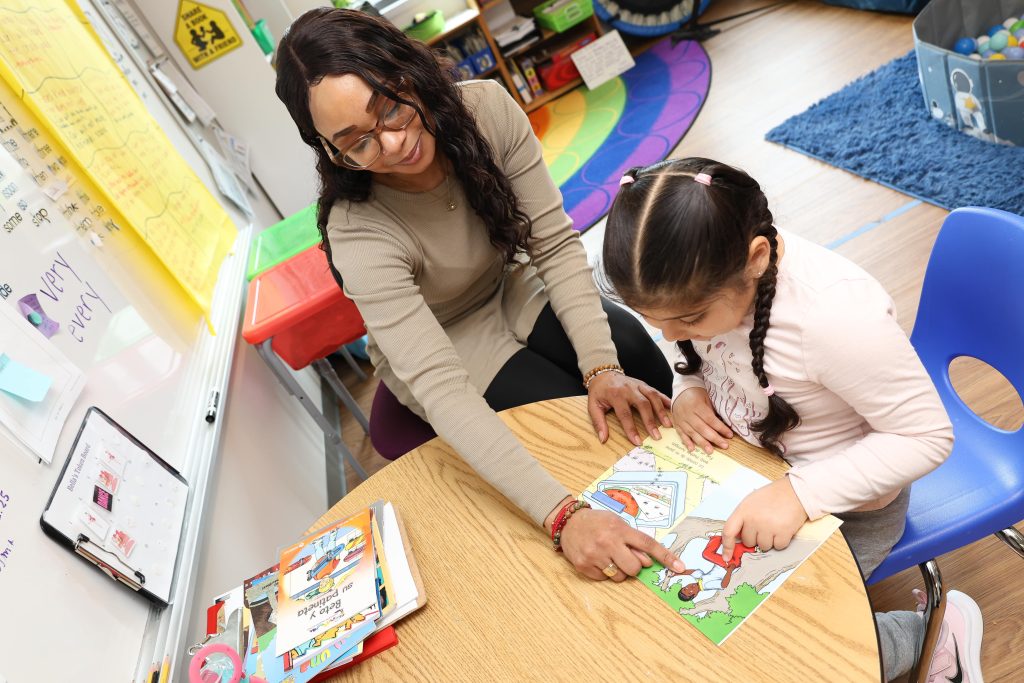
We’re excited to spotlight one of our incredible Demonstration Classroom educators from DC Bilingual PCS (DCB), whose work in the Learning Lab brings data-driven and student-centered instruction to life every day. In this Q&A, Kyla Skrine, the founding teacher behind DCB’s Learning Labs, reflects on what makes the Demonstration Classroom model so powerful for students, educators, and school communities—and how intentional collaboration and flexibility drive real outcomes for students with disabilities. Here’s our conversation with Kyla.
When you think back to your first weeks in the Learning Lab, what moment made you say, “Yes—this is why I’m here”?
KS: When we launched Learning Labs in 2018, shifting from small, self-contained classrooms to more inclusive and flexible learning spaces, I felt the same excitement I had when I began my career as a dedicated aide in 2013. Those early opportunities to learn lesson planning, differentiation, small group instruction, and how to create joy in the classroom shaped my desire to support students in unique ways, as well as extend the work to develop paraprofessionals in Learning Labs. I also quickly saw collaboration strengthen among all stakeholders, including teachers, paraprofessionals, related service providers, and general education teachers, whose collective work is essential to the success of serving students in Learning Labs.
What student progress this year makes you the proudest?
KS: While we value inclusion and opportunities to highlight students’ strengths and areas for growth, our overarching goals are to narrow achievement gaps and support students in attending and participating in their general education classrooms alongside their grade-level peers. Over the years, Learning Labs have helped us achieve these goals in many ways, from reducing the need for full-day 1:1 support, to successfully pushing students into general education classes for part or most of the day, to ensuring students can access and participate meaningfully in schoolwide and special events. In addition, DC Bilingual’s special education students continue to outperform other special education students in DC on standardized assessments in ELA, Math, and Science, demonstrating the growth and independence fostered through Learning Labs. We explicitly teach students how to use their accommodations and regularly teach self-advocacy at their level.
What practice do you now consider “non-negotiable” because of your experience working in the Learning Lab?
KS: There are a few non-negotiable practices in Learning Labs. Building strong relationships with students and team members forms the foundation. Intentional planning and collaboration create meaningful connections with students and help bridge learning gaps. Our primary goal is always to narrow those gaps, in whatever way is needed. Effective special education requires regularly analyzing data, adjusting strategies, and thinking creatively to support student growth.
Where do you see the Learning Lab model helping schools rethink supports for students with disabilities?
KS: The success of Learning Labs depends on intensive, careful, and intentional planning with administrators who are fully invested in this work. Each spring, our team holds multiple planning meetings to create student groupings, assign students to the Learning Lab that best meets their instructional, sensory, and neurodiverse needs, and determine teacher caseloads and intentional paraprofessional or aide pairings for the upcoming school year. Throughout the year, we collect and analyze data from multiple sources and use it frequently to inform our decisions. Our model prioritizes the “whole child,” considering the needs of every student we serve. Supporting students with disabilities requires making modifications as needed, which demands flexible mindsets and the ability to pivot. As educators, we must be present, consistent, adaptable, and creative.
If you could share one message with other DC educators about this work, what would it be?
KS: In these unique times, our roles as educators are more critical than ever, and our actions and attitudes can create meaningful impact and change. As special educators, our efforts directly influence student outcomes, as reflected in our data. It is essential to take care of ourselves and our minds so we can continue to think creatively, go the extra mile to support students, and work to narrow learning gaps whenever possible.
Interested in learning more about our Demonstration Classrooms and how these models support high-quality specially designed instruction across DC charter schools? Visit our website to explore the Demos and see how schools can get involved.