
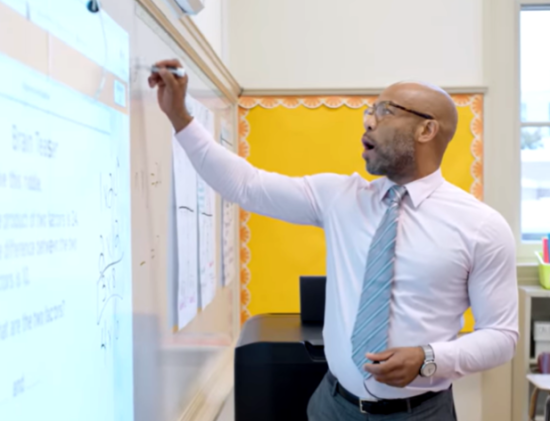
For Mr. Griffin, math intervention is about far more than numbers, it’s about building confidence, fostering perseverance, and helping students discover what they’re capable of achieving. As a Math Intervention Teacher in the Co-op’s Demo Classroom at Thurgood Marshall Academy PCS, he has dedicated himself to meeting students where they are, celebrating their progress, and creating an environment where growth becomes possible for every learner.
Why did you say “yes” to becoming the Math Intervention Teacher in the Co-op’s Demo Classroom program?
I said “yes” to becoming the Math Intervention Teacher in the Co-op’s Demo Classroom program for various reasons. One reason being my love for the subject matter. I knew that I would be able to implement the curriculum effectively and in a manner that would make it easy for my students to understand. However, the most important reason is my love for seeing student growth and success. The Math 180 curriculum is one that begins easy, but gradually increases in difficulty level. To see my students go from not wanting to do math because they believe it is too difficult, to not wanting to stop working and even assisting one another with their work is one of the greatest fulfillments as a teacher.
When you think back to your first weeks as a 180 teacher, what moment made you say, “Yes, this is why I’m here”?
When I think back to my first weeks as a 180 teacher there was not a moment that made me say, “Yes—this is why I’m here.” I began teaching the curriculum during Covid so I was not able to get complete buy-in from students virtually nor instruct in the manner that I was used to at the time. However, upon returning to the school setting after Covid, I had that “ah ha” moment when I witnessed the students that really invested into the curriculum seeing the results of their efforts and residually having an increase in their math confidence. It was very challenging because students were adjusting to being back in the school building, but through perseverance and the need to want to see my students always succeed, I stayed steadfast and would not let my students settle for giving up when the work got harder. I always pushed my students to get as far as they could, but always at their own pace.
What student progress this year makes you the proudest?
The progress made by my student Malik has made me extremely proud. He came out of the gate on a very strong note and never let up. Upon noticing his skill set, I appointed him as assistant teacher of the class. His duties included assisting his peers with their work if I was occupied assisting another student. This led to his peers asking him for help before me, and even motivated other students to take it upon themselves to aid their peers without being asked. Malik is also the student that has gotten the furthest with the curriculum.
What practices do you now consider “non-negotiable” because of your experience working in math intervention for high school students?
The practices that I consider “non-negotiable” because of my experience working in math intervention for high school students are the same as those that I possessed prior to teaching the curriculum–failure is never an option, teaching students that they are capable, reminding students that they are smart, staying consistent, always inspiring, and never giving up until the lesson is fully understood.
Where do you see intervention programming helping schools rethink support for students with disabilities?
Intervention programming should be an integral part in helping schools rethink support for students with disabilities. When implemented properly, such programs assist students by meeting them where they are and providing the essential steps of understanding. Instead of assuming that a student already has the basic steps, the program actually determines where they are and builds upward. For students with disabilities this method can ease anxiety/stress while building confidence. Additionally, it can aid the same student population across other subject matters thus helping the student become well-rounded academically.
Mr. Griffin’s story is a powerful reminder that meaningful intervention is about more than accelerating academic growth; it is about helping students believe in themselves and recognize their own potential. As highlighted in his recent video feature and HMH’s Growth in Motion spotlight, his impact extends far beyond the classroom, creating lasting relationships and inspiring students to see new possibilities for their futures.