
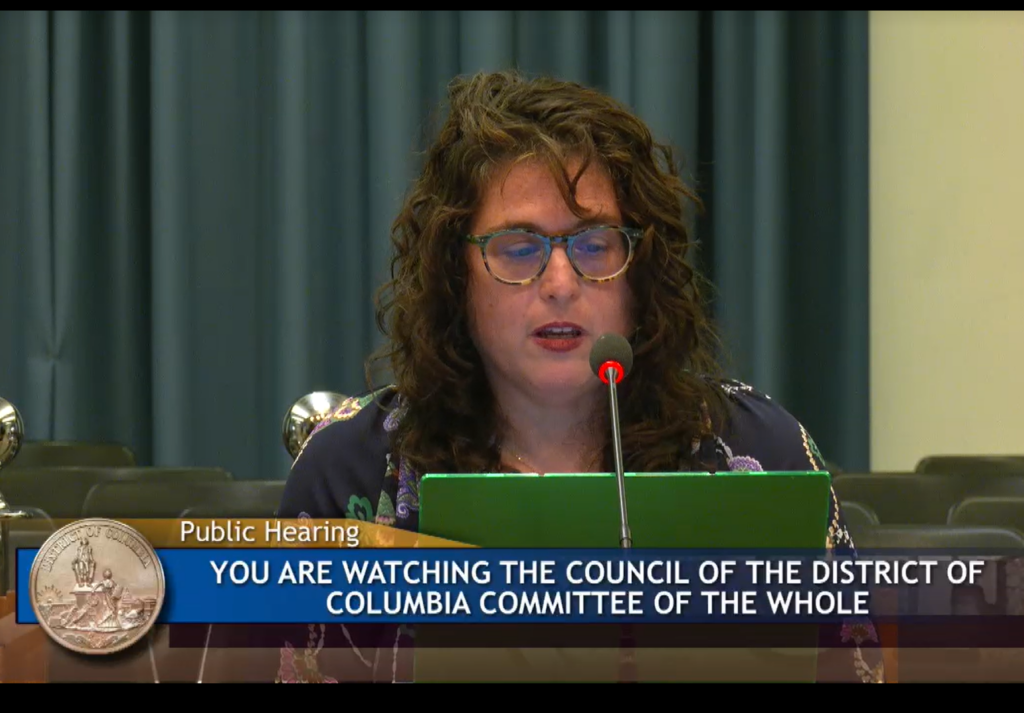
On November 4, 2026 the Co-op’s Executive Director provided public comments to the DC Council. The hearing, Oversight of Education for Students with Special Needs, provided the organization an opportunity to provide recommendations for accelerating outcomes for students with disabilities.
Thank you, Chairman Mendelson and CMs, for allowing me the opportunity to submit comments regarding special education in the District. My name is Julie Camerata and I am the Executive Director of the DC Special Education Cooperative or the Co-op. The Co-op serves 60 charter LEAs and our vision is that all students with disabilities in the District of Columbia are empowered and equipped to lead meaningful and connected lives.
We, as a city, can’t keep doing the same thing and expect different results. Students with disabilities in D.C. are being left behind. Outcomes haven’t significantly changed in years. We need: a citywide vision, ambitious targets, and investment that scales what works. I have some big picture recommendations included at the end of these comments, but I’d like to use most of my time today to talk to you about a practice that is making a huge difference with students across the educational spectrum: students with and without disabilities and English Learners. UDL or Universal Design for Learning is a framework and approach to instruction based on the science of learning that recognizes that learner variability is the norm and that no two students learn the same way. It provides a structured framework designed to remove barriers and build in flexibility for how students access information and demonstrate their knowledge. When applied in the general education classroom, UDL can create equitable access to high-quality instruction for all learners. One of our Demonstration Classrooms has been quietly perfecting their UDL implementation over the past six years. I always describe this classroom as magical, but it’s not magic. Student results come from an intentional set of enabling conditions. They are:
- Mindset: All adults in the building believe that students with disabilities are capable of more. It’s that simple.
- Leadership: Leaders make decisions that support improving outcomes. For example, they protect collaborative planning time so teachers can design lessons with multiple ways for students to engage, access information, and show what they know, then refine those lessons using student data. UDL takes more than an individual teacher’s effort; leaders need to align schedules, professional learning, and coaching to support it.
- Data-driven planning: Our UDL classroom didn’t pick this framework because it was buzzy or of the moment, the decision was made based on data. In this case, leadership looked at how students with disabilities were performing across the continuum and saw a weakness in their core curriculum and Tier 1 implementation. That made UDL the right fit.
- Professional development that works: Adult learning theory should guide how we develop learning opportunities for our educator workforce. Our UDL work is grounded in adult learning theory and job embedded professional development. Training needs are assessed and provided across the staffing continuum, from school leadership to teachers to aides.
- A strong Tier 1: This is where the UDL framework comes into play. It allows all students to access the school’s high-quality curriculum.
These conditions are not unique to UDL; they are fundamental to strong schools. And when we look beyond UDL and serving students with disabilities in the general education classroom (Tier 1), I would add a sixth condition: A strong Multi-Tiered System of Supports or MTSS. Students with disabilities are not a monolith and if the city
wants to see better results, we need to stop problem-solving as if they were. Schools need to identify what each student needs and provide the right combination of services across a continuum. Our Demo classrooms – which demonstrate excellent implementation from Tier 1 (UDL) to Tier 3 (evidence-based intervention) and specialized environments (Learning Labs) are proof points of what is possible IF all of the enabling conditions are in place. The last condition I need to mention is funding. We built these classrooms with SOAR and SEEF grants from OSSE. This seed money was crucial, however all Co-op Demos once built, have been sustained through LEA budgets.
As you consider budget priorities, I urge the Council to:
- Ask the DME and OSSE to set ambitious goals for students with disabilities. These goals must be based on data and center student outcomes. Goals should operationalize a mindset that all students can succeed when provided the appropriate services.
- Ask OSSE to create an easy way for LEA and school leaders to see their SEPR data in real time. Currently, LEAs receive reports with stale data which can be a barrier to programmatic improvement.
- Develop a comprehensive, citywide professional learning strategy that accelerates improving outcomes for students with disabilities. The Co-op’s 2023 ALL IN summit which brought together LEA leaders, parents, students, and policymakers, offered a set of recommendations for improving special education. One of the recommendations in our ALL IN report highlighted the need for all teachers to have a basic understanding of special education. A 2026 national survey by NCLD–WestEd underscores the need to better prepare and support educators: among 1,654 general and special educators surveyed, only 42% of general educators said they felt completely confident adapting instruction for students with learning disabilities. Among novice general educators the figure was 17% [State of Learning Disabilities: Strengthening Educator Confidence to Support Every Learner]. To maximize the return on this investment, the strategy should be developed in partnership with LEAs, reflect their needs and build on existing efforts. It should also include clear ways to measure whether professional learning is strengthening educators’ practice and improving student outcomes. While I firmly believe that we need a coordinated citywide strategy, we can’t wait for one. This year the Co-op launched ALL IN DC, a multi-tiered professional learning initiative designed to strengthen educator competencies, build school-based capacity, and transform outcomes for students with disabilities. Its five interlocking programs for teachers, special educators, dedicated aides, and leaders form a citywide pipeline for instructional excellence and leadership in inclusive education.
- Consider creating an innovation fund to support initiatives like the Co-op’s Demonstration classrooms and ALL IN DC initiatives.
- Visit one of our Demonstration sites this spring to see equity in action. In the meantime you can watch a video of our Demo classroom made by CAST.
We all understand what is at stake, our Demonstration sites show us what’s possible. Let’s ensure that the success seen at our demonstration partner schools becomes the standard across every school in the District.